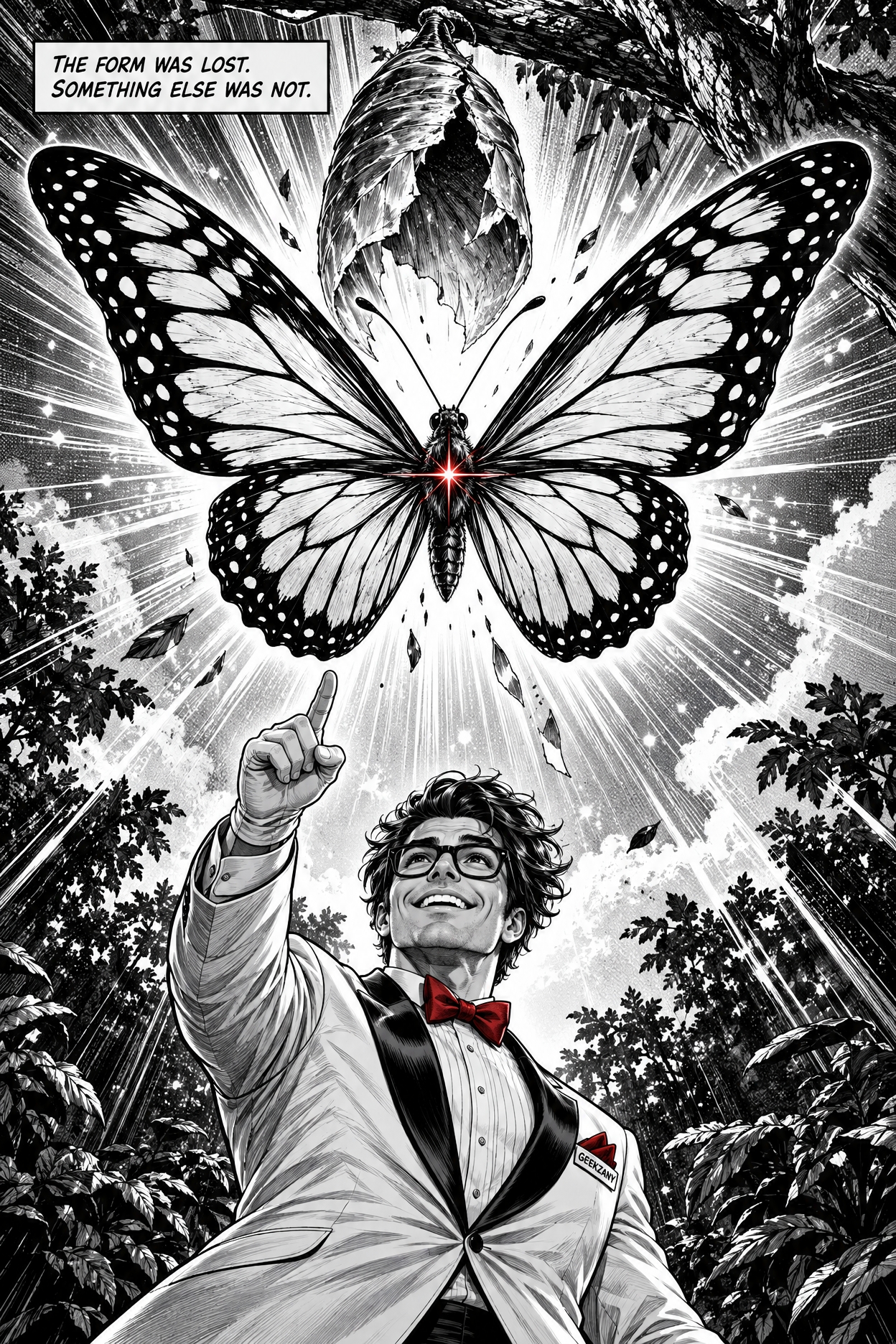
What if reality itself runs on the continuous generation, transformation and recycling of information?
Tonight, Geekzany is serving you a question, in six issues.
“What the Butterfly Keeps” is the theme of the Cosmic Information Recycling Hypothesis:
a song about what comes through when a form is taken apart and rebuilt.
The form was lost, but something else was not.
Hypothesis ThemeIssue #2Read-Along Track
ISSUE #1
The Machine That Never Stops
Imagine a computer with limited storage capacity. Every second, new information is created. New data is processed, stored, and continuously added to the system.
But what happens when the storage eventually becomes full?Does the system erase its past? Does it overwrite what already exists? Or does it transform information into something entirely different?
Now imagine that this computer isn't a computer at all. Imagine that it is our universe.
What if stars, black holes, life, and even the universe are parts of a much larger information system?
This is the question behind the Cosmic Information Recycling Hypothesis. To explain it, we begin with something much smaller than the universe: a butterfly.
ISSUE #2
What the Butterfly Keeps
A caterpillar does not simply grow wings. Inside the chrysalis, most of its body breaks down. The creature that crawled along the leaf is, in a real sense, gone.
Drag the slider. Inside the chrysalis, most of the body breaks down.
And yet what emerges is not a stranger. In one experiment with moths, which transform the same way butterflies do, the adults avoided a smell they had been trained to dislike as caterpillars. The body had been taken apart and rebuilt, but something learned had come through.
We see the same pattern wherever we look.
A tree falls and becomes soil, and the soil feeds other trees.A star burns out and scatters the elements that will one day form planets, oceans, and us.
Physical forms are temporary, while some of the information they carry is passed on.
That is a large thing to wonder. So we start with what is actually known.
ISSUE #3
What Physics Says About Information
Physicists take a version of the computer question seriously. Any region of space can hold only a finite amount of information, and the objects which hold the most for their size are black holes. Erasing information is never free: wiping even a single bit releases a tiny amount of heat. Information is part of the physical world and bound by its laws.
Consider burning a letter.When something falls into a black hole, and the black hole slowly evaporates, is the information truly erased? Most physicists now believe it leaks back out, scrambled, like the letter in the fire. The question is still not fully settled.
The universe is not running out of room, and black holes do not form because some cosmic hard drive is full. They form because of gravity. What the physics suggests is narrower: nature, as far as we can tell, does not delete. It transforms.
If something continues, does all of it continue, or only some of it?
ISSUE #4
What Gets Passed On
The forest does not keep the tree.
Most of what the tree was ends with it, and only a part is taken up into the larger life of the forest. The same is true of a star, of living things, and even of our own minds.
No one is doing the choosing. The forest has no committee.
What carries forward is simply what can be used, what fits, and what lasts. Tap each card to see what ends.
Here the hypothesis leaves established science behind. Picture reality in levels, each one nested inside a larger one. At every level, information is created, used, and recycled locally, and most of it stays there. But when a form comes to its end, some part of what it was is absorbed into the level above.
I call this selective integration. Nothing is deleted, but not everything is carried upward either.
The Universe
The Galaxy
The Earth
The Forest
The Leaf
Start at the leaf. Press the button to follow the red thread.
I cannot yet say what does the selecting, or by what rule. Physics has no such law, and I may be seeing one pattern where there are only several that look alike. That is the weakest point of the idea, and also the one most worth investigating.
ISSUE #5
The Body and the Soul
Start with what we know. When a person dies, the body goes the way of the fallen tree. Its atoms are not lost. They return to soil, air, and water, and in time to other living things.
A life leaves more than material behind. Children carry genes. Words stay in the memories of those who heard them. The things a person built, taught, and changed go on shaping a world they are no longer part of.Could what we call the soul be the human version of that: not the body, and not every memory, but some essential part of what a life was, carried into something larger than ourselves?
The physics does not support this. When physicists say information is not destroyed, they mean the scrambled traces in the smoke, not the letter itself. Nothing in science shows that a person's memories, character, or awareness survive the death of the brain. The soul is offered here as an analogy and a question, not a conclusion.
If the pattern holds from the butterfly to the star, does it stop at us?
ISSUE #6
The Question I Leave Open
If existence really does work this way, the next question is why. There are several possible answers. Open the doors.
My own sense is that change happens for a reason, and that each level exists because the next one needs it. But that is a belief, not a finding. I do not know who or what set all this in motion. Nobody does. So I leave it open, deliberately.
This hypothesis is not a religion, and it is not yet science. It is a way of looking at things, and it should be tested, challenged, and changed wherever it turns out to be wrong.
A caterpillar inside its chrysalis cannot know what it is about to become. It may be that we are in the same position.